With 37 years in the business Laurin Rinder has done thousands of interviews but I could only find one, so I decided to
have a go at it myself. You can find out a lot about his work online and from his website (rinderart.com) but there's
still so much that has never been documented about his career. I only recently read about albums called 'Full
Circle' and 'Half Circle' and I'm sure the search results of his television / film work is only a partial list. Last week
I tracked down a copy of a movie Laurin and Michael had scored called 'New Year's Evil', but after my conversation
with Laurin I found out it's really only the tip of the iceberg.
LR: There's about 48 or 49 albums that were in the whole 7 to 8 year period of the run that we did plus 435 TV shows and
35 films that we wrote and produced the music for. All the ninja series. Enter the Ninja, Ninja 3 The Domination...
all those.
BB: How did you guys started before we get into your disco and soundtrack work ?
LR: Always the biggest misconception is our background. I was a rock and roller and a jazz guy and when I was 19
I was playing with some of the biggest jazz artist of the day. I was in hog heaven. Nineteen and growing up
with jazz and my dad was a jazz guy.
BB: So basically through your dad you got started doing music ?
LR: My dad understood the passion for music and he was cool about it. He was a rocket scientist. He started Cal Tech. Yeah,
I was probably about 9 to 10 years old when my dad was an understudy for Bing Crosby. He sounded like Bing,
pretty much nailed him. When Bing Crosby was back east and needed somebody to be him, he would go into the studio and do
it. Its always been done. I've played drums with 12 different groups calling themselves the Coasters.
First I started playing the trumpet and that didn't last very long because it was kinda silly and then I started playing the
saxophone and I was always in dance bands because rock hadn't started yet. More Rockabilly and Country & Western. Played
with a few groups and sax was THE instrument to play and then when I was about 14 years old... the Drums. Drummers
seemed to be having a lot more fun, get noticed and the girls really liked them. That has a lot to do with everything.
If you break it down, 99% of the reasons why performers get on stage, because people like you... acceptance and all of a
sudden girls look at you differently. Pretty easy decision.
BB: Was it hard to get a break into the scene at the time? Were there a lot of drummers around ?
LR: There were a lot of drummers in town because I'm from Hollywood, Hollywood High. There were a lot of studio drummers
doing legitimate stuff and movie scoring. Then when rock morphed out of R&B and Rockabilly and Country, they didn't dig
it. They didn't think of it as music. BMI came around to satisfy the need of the new stuff. Rock wasn't accepted and
ASCAP wouldn't even accept you and so BMI came around in the mid 50's and started a new thing because of the new youthful
music that was coming out and the new guys went with them.
BB: So at first your Dad helped you out to get studio and session work?
LR: My dad was my roadie and would drag me around to all the little recordings studios in Hollywood and I would hang around
in the alleys because I was to young. Until they finally said "What do you do?" "I play drums". Right place, right time.
Then they would start calling and you get a reputation.
I quit high school at 15 and went on the road with Tommy Sands in the mid 50's. Went on the road with him and got a fake
id and my dad was very cool about it. He was really behind me on the whole thing. He said if you want to quit school
that's fine and I moved out at 15 and had my own apartment in Hollywood. Had fake ids and tried to grow a mustache.
BB: So after that tour, you went back to doing more session work ?
LR: Constant, i literally played on about a thousand albums. I never found out what album it was. Back then they would
give you $20 a session and musicians never got credit. Most of the time the records were made by publishers not by
Record Companies and the Record Companies would buy the rights from the publishers. Berry Gordy was brilliant because he
was a tune-smith. He had a philosophy of "an infinite amount of monkeys with an infinite amount of typewriters and they
will eventually write the greatest book". He got this gigantic building in Detroit like a whorehouse. It had like 900
rooms and he put a piano in every room and a black guy in each room and sat them down and said "Go". For $200 a week, and
in the early 60s that was a lot but he took all publishing and royalties. He basically recreated that whole Tin Pan
Alley turn of century thing. If you look at the early Motown stuff, under the song title it said the "Corporation" and that
was Berry Gordy. We did demos all day and we never knew who the artist was.
BB: Who all were you working with at the time ? What other musicians were there ?
LR: Bernard Purdie, Earl Palmer and few other drummers. We would just sit and play and we would just lay down these tracks
one after the next. At the end of the week you did 50 songs. Not all hits but he would release everything. He would release
the song with every artist he had. Smokey... all the people. He would put it out and whichever started getting some play
he would pull all the rest of them back. Total genius.
BB: So if you heard something from back then now, would you remember if you played on it?
LR: I might kind of go "Yeah... I remember that". Songs like "Mother-in-Law", and "Get a Job" and Fontella Bass "Rescue
Me", its hard to remember. If you listen to 'Oldies but Goodies' stations i probably played on half of that and Bernard
Purdie on the rest. They never wrote down who played on a track. We never thought of royalties.
BB: And how old were you when you were doing this ?
LR: Late teens early 20s. One of the youngest that understood that kind of stuff. I was with James Brown too at the
time. The only white guy traveling in buses in the south and scared to death!
BB: And the whole time your only playing drums or where you playing other instruments?
LR: Just drums. With James it was 3 drummers, beats the one drummer couldn't play. James was pretty brilliant at that.
But I'd later go on to play other instruments and that's where my work with Michael comes in.
BB: So from there you moved back to LA and started playing again before you met Michael?
LR: I had a band in the 60s called the Four Sounds, a very successful bar band. Our friends were the Turtles, the Byrds
and we'd play Sunset blvd. and in the 60s there were tons of clubs. We did that for a few years and the guitar player
was Deke Richards, he and Freddie Perren produced some of the biggest R&B songs of all time. Had a thing about never
taking a bath. A white guy that always thought he was black, he would say "I cant take a bath because it would wash the
soul off". Another guy, the organ player went on to form the Grass Roots. Well we decided to get rid of Deke because he
was getting kind of crazy, he said he was going to Hollywood and write R&B hits and he did just that and made millions.
He wrote "ABC" for the Jackson 5, amazingly huge copyrights.
Also played Hollywood Bowl with the Righteous Brothers once. It was the third bill, this stupid group called the
Beatles. "Who the fuck are these guys look at that goofy hair". We had pompadours, lots of hair spray. They had their
hair combed down and like these triangle shaped amps and we were backstage just cracking up at these guys saying "Who
are these idiots?" But the audience went insane. I remember a deafening roar. In those days girls didn't scream, they
would sit there politely and applaud. But as soon as they came on I had never seen anything like that before in my life,
screaming young girls. After the show they found about 300 pairs of girls panties in the audience and that just shook
everybody so much,I'll never forget that. "What did we just see?" That was '63 their first American tour.
But during the 4 Sounds era there was a group we were really good friends with called the Standells and they were
traveling with the Stones.
Later on I got a call from Dick Dodd, the lead singer of Standells, and he said he needed a new drummer and to come and
audition. The band would be called Joshua. And that night I met Michael Lewis and Murray Tarlyton and I brought Ruben from
the Righteous Brothers. We hit it off that night and started the group and did a few albums.
BB: So this band Joshua didn't work out? What did it sound like... the Byrds or something ?
LR: Nah, it just dwindled. It a heavy duty glam kinda thing with high heels and flames on your face. It was pretty gay
shit. We started playing some clubs and it fell apart.
And then Mike went with "We Five" and then we stared another group the LA Bullets. I got some guy to put up like twenty
grand so we could pay everyone to quit their other band and just rehearse because Michael was writing this Rock Opera, that's
what the project was. "Amrackis, the Chronicles of the Starship Trinity". Took a year to record. Biggest fiasco in the
world.
BB: Did this band ever perform live or have any plans to ?
LR: Could have been, it was this futurist thing about saving the world from water or some kinda bullshit. i didn't write
it. I just Played on it.
But the manager at the time was Seymour Heller who was a big player and owned the Producers Workshop. So there was our
studio and we had anything we wanted we would go there and drop acid and sit on the floor. Then the disco came in...
BB: So how did you get introduced to Disco ?
LR: We were under contract with them and one of the guys from AVI went to New York, Ray Harris and rap was just
starting. Just street stuff, just like the guy would do beat-box with his mouth and he had tapes he would bring back of
it, but it wasn't called rap I forgot what it was called, rap came years later. But he said he had heard this other
thing when he went to other place and they were playing this, what they called "disco music". It started in New York
and moved to LA quickly.
We lived right behind the place called Studio One that held a 1000 people in this giant barn, in West Hollywood which is
pretty much gay central. He said I want you two guys to go down to Studio One tonight and listen to this disco stuff and
see if you can do this. And we were hardcore long hair Rock-n-Roll guys with Jazz backgrounds and we went "OK sure". We
were under contract. Mike and I went in and sat there amongst these sweaty gay guys screaming and yelling and were
saying "What the fuck is this?" We were just shocked at what was going on. We'd never seeing anything like that.
Life changes when you turn left or you turn right, that is exactly what happened that night. Instead of Mark Bryson
being there, Mike's roommate, and both of them going. Michael and I went. I could have just missed the meeting that day.
BB: What exactly were they playing in the club that night when you guys went ?
LR: It was this remixed R&B Motown stuff, Van McCoy's "Hustle" hadn't come out yet there was a little bit of Barry White when he
did "Love's Theme" and that was THE state of the art. We knew we could do that because we loved to score things and thats
what it was. It was a lot of bass drums and booming and whistles and yelling and we said we could probably do this in
about 20 minutes. Because we were technicians we could do anything. We could probably do this... so the next day
Michael and I went into the studio and we came up with "Lets Get It Together".
BB: So they said go down there and try to do something like what you hear in this club?
LR: Yeah, try to make a dance record. Originally it was 9 minutes long and there was a hook line and thats it. A catchy
beat and bunch of fake strings on it and we orchestrated the shit out of it.
BB: So you just kept going from what you heard that night and making more tracks like it ?
LR: Well, then Simon Soussan came along. He heard what was going on and he was this really rich Arab guy and he had the
money. He bought 16 track masters from Motown and got Mike and I to update them. He paid us a fortune! We would add
drums and high hats and whistles and sounds. So we put that out and it became big hits and he kept on paying us $1000 a
day to do this.
BB: So would Simon give you guys directions or advise you to what he wanted it to sound like ?
LR: He just stood there and had the money and was smart enough to see the trend. His family owned the biggest clothing
business in the world. We'd just be making the songs better or stronger or edit them and make them longer.
BB: At the time you weren't really trying to make radio songs at all right ?
LR: Just club music, but we would edit it down for radio once we found out it was serious. Then El Coco takes off and
then Le Pamplemousse takes off and all Le Pamplemousse was was a little bit blacker version of El Coco and we'd put phony
names on the back of the albums. Washington Soul Man Jones, Pete Turner on trumpet. Pete Turner sounds like a trumpet
player.
BB: So who came up the idea to put all the fake names on the albums ?
LR: That was me. We had to come up with names to make it look better. Just a perception. Like the 1910 Fruit Gum Company
and Parliament were all fake bands. All the same players.
BB: But you would have some guests play on your records or no?
LR: Yeah sometimes. We would have specialists come in but no one would know from the credits. Couple guys from Earth
Wind and Fire would come in. Each group had its own group of singers and that was really the only way to differentiate
between the different groups.
BB: So who was the one coming up with all these band names ? El Coco, Le Pamplemousse, Discognosis, Cheetah?
LR: Ray Harris named them. Just to make it different, make it sound like the group was from France, that was Le
Pamplemousse... we didn't really do anything that different. He came from the days of the Classics 4, those were all
fake groups, just studio guys. We would just do something new and he would make up a new name... there was one called
Sweet Potato Pie and another the Coney Island Chorus Girls. We would try everything.
So then, our promotion man at the time, in St. Louis, was AJ Cervantes and he came out to LA and he had just got a lot of money
from his dad to start a label. He approached us immediately and said "I want you to do the exact same thing you did for AVI but do
it for us". Well it will cost you a lot of money and he said "OK, I got a lot of money".
See, AVI was kind of the low end of the record business, not very flashy. You can tell from the albums. AJ was the
opposite. His stuff was glossy and his girls were drop-dead gorgeous and he was into the lesbian thing. We all lived at
the same high-rise on Sunset and we were all sitting around the pool one day and AJ was figuring out the business model and said
"Lets have a group called Saint Tropez" and they would all be from France and we will get three gorgeous girls to be in
it and spend a fortune on the glossy covers and dip the record in pink and get the best photographers.
BB: So you guys weren't under contract then with AVI ?
LR: It didnt really matter, this was just an independent thing at that time. Saint Tropez then took off because of a marketing scam, by
sending all the records to Europe and then importing them. So Saint Tropez was an import and cost more here and he paid for
the shipping. More people would buy it because of that. At the same time you had Cerrone and Donna Summer and everyone was catching on.
These sold way more then AVI records and got us more awards.
They were very expensive albums. Say AVI spent 5-6 thousand on an album and AJ would spend like 50-60 thousand on Saint
Tropez record which would be like 150 thousand now. Real orchestras with big string sections and we brought in huge horn
sections and got very legitimate singers. Girls on the cover had nothing to do with it.
BB: Did you have any say in what exactly was going to be written and released at the time?
LR: Yeah, then I came up with, lets do music from the 30s' and 40's but discoize it and so i went to Billboard and got
all the hits on microfilm. Mike and I had complete creative control. None of the head guys came to the studio.
BB: Wait, so this is all at the same time you were doing the AVI stuff?
LR: Yeah, 9 different groups, we lived in the studio, we really had cots, beds and the whole thing, we were just
pumpin' them out. 7 days week, 3 different projects at the same time. I played drums on everything but had to play a
little differently. I had to ask the engineer "What's the name of this group?" The sheet would say but I would have no
idea and the next track might be El Coco. But Mike and I would decide and assign the track to different group names and
listen and say "Hey that sounds like an El Coco track".
BB: So there must be tons of unreleased tracks !
LR: Oh yeah. The 'Half Circle' and 'Full Circle' albums were just dead tracks, extra stuff. A mix of years and groups,
anything.
Then TV started. We weren't even thinking about it and we were on a plane and happened to sit next to a guy who was doing an
ABC After-School special and asked if we wanted to score it. Well then it got nominated for an Emmy
so then we got an order for 90 shows then 100 shows and all this at the same time.
Its amazing what took me hours to do then, has bought me homes. The theme of 'In Search Of' was written on the way to the
studio, i had every theme song to every show ever produced on cassette in my car and i would listen to them and just
change them up to make something new.
BB: All this was done in the same studio or would you work at the TV stations studio?
LR: Yeah, all working in our studio at AVI. Then films came in.
BB: How was working with films different from your other studio tracks?
LR: We would sit and spot the film and the director would tell us exactly how he wanted it. In one episode of 'In
Search Of' in a 22 minute show there was usual up to 40 music queues with 10 second segue-ways. Each cue was designed
and timed perfectly to the tenth of a second.
BB: And you then later released this on AVI ?
LR: Well then the show got popular and they decided to take the best cues and orchestrate them and make a concept
album called 'Music from In Search Of'. Seven or eight pieces which were expanded versions from the show. AVI and Alan
Lansberg thought of the idea as a publicity scam.
BB: So when did you eventually decide to use the 'Rinder/Lewis' name for you production work?
LR: After Accepting a lot of awards and saying "Sorry the band is out touring Europe right now and cant be here tonight". The
charts and Top 40 were getting serious. Then I sort of let the cat out of the bag in an interview.
We were really afraid that someone would catch us and the bubble would break and we couldn't drive our Ferraris around.
We had 3. Yeah, buying buildings. Scared to death that something we couldn't understand from the beginning was turning in
to such a big deal. After all our records and TV, our royalties were getting out of hand and we didn't want anyone to
know we did all this stuff. The back story never came out of how it all happen. Then i did an interview which was titled
'DISCO PRODUCERS REVEAL THEMSELVES' it was in the LA Times or something. Then the shit hit the fan and one of the
reporters from 60 Minutes, because his wife was big Tuxedo Junction fan, got talked into doing a piece on us. I
never got a copy of it, I'd love to see it. I was so Hollywood in it too, shirt open down to the belly. It was Disco City! It
aired and shit hit the fan and up until then, no one really knew what I was doing. Everyone now thinks Im a
millionaire, because Im on TV. EVERYONE saw the show. No one really put it all together until this piece came out.
I said to Michael, we should come out of the closet now... so why don't we do an album and call it "Rinder & Lewis". The
record label was totally against it and I wanted complete control of it. Wanted an album that looked really good and so went
to best photographer in town and shot the cover for 'Seven Deadly Sins'.
Then with 'Warriors' I took the album cover photograph on a fishing trip with our dads. They were both standing there
looking gruffy and mean and I said "Lets just call it 'Warriors'!". Everyone thought it was us! Everyone would say "What
happened to them! First album they looked like a couple of gay boys and now this?".
BB: I love that album cover! How did music for 'Warriors' come about?
LR: Well, that all centered around 'Willie and the Hand Jive'. One of my earliest influences was Johnny Otis. Who did
the track, I've always wanted to do this song. We even did it in Joshua too. Then came 'Cataclysm' and that was more Mike
then me, more conceptual.
BB: I still haven't heard that album yet. How would you guys start working on album like 'Seven Deadly Sins'? You
obviously had the concept for each track title already.
LR: Michael and I called it 'Red Light Fever', never rehearsed and never really had a concept. He would sit at his
piano across the room and I would sit at my gigantic drum set with my headphones on and we would just start and hit
record and whatever came out. After 3 or 4 minutes maybe, find it ain't happenin' and start again. Everything was
isolated so we could change everything afterward. Basically we'd get the feel of the drums for what we were going to do
because most of the time the keyboard would change. Then we'd add bass, it was like a painting. It just evolved. One
night Mike had to leave to pick up someone at the airport and I was left in the studio. So I said bring me every drum
you have, i dont care, get everything and have it here in an hour. So they brought them all and Mike came back and 'Anger'
was done. I'm grunting and growling and I beat the shit out of whole bunch of crap, tour de force of drums. Then after
that... this one is called 'Lust', its sexy and slower and cool and diminished chords, and it just worked.
BB: An that took about how long to complete ?
LR: No album took longer then a month including working on TV shows.
BB: WOW!
LR: The amount of coke we did to do all this you cant even imagine. $300 a day. I had to had have plastic inserts in my
nose so i could do more. We watched the sun come up for 10 years. Me, Michael, engineers and whatever girls we could
get to come down.
BB: So during all this, you never left the studio with any of your projects, no tours at all ?
LR: There was a group called El Coco in Chicago, started by AVI. But we didn't even know them. We never saw them, they
just learned the songs. We had no interest at all.
Then Butterfly stared two touring groups all over the world and they would sing to tape, thats all. We would interview
them but thats about it. They never sang on any albums they just looked really good. In fact the youngest woman on
Tuxedo Junction was 55 because they had to sound like the original stuff and very few young session singers could
understand.
BB: So what other disco artist/producers where you listening to at the time ?
LR: None, weren't concerned with it, we wanted them to listen to us. Went to Studio One that one time that's it.
BB: What was that last thing you guys worked on together ?
LR: We split in '82, just from being burnt. Either that or die. I was going since I was 14 and I had enough money and
owned copyrights and he wanted to keep going. He did a few TV things by himself and I did an Eloise Whitaker album by
myself. It wasn't anger, it was just time to do other things.
BB: Yeah if found something called S.S.T. from about 1983 and it was the first time i didn't see your name listed next
to Michael's.
LR: Yeah there's hundreds of things of just Michael. I just stopped completely. Michael got involved with Diamond Dave and
doing music directing on cruise ships. He made a lot from that.
BB: Are you still in contact at all ?
LR: Ran into him at Pavilions recently, we happened to be standing next to each other. He lives like 2 miles from me. He was
standing there and I ran up to him to be the next guy in line and I said "Imagine that!" Talked for a bit and then he
just drifted off. Something happened between us that was bigger then I can remember. I don't know. It's a shame, we were together
for 25 years. We would take a month off ever year and we go somewhere. South America then to Africa.
Michael was more into the studio. He enjoyed it more. He loved late nights and i wanted to start at 10 instead of open
ended. We would go until we couldn't see straight or couldn't standup. He would keep going. I just couldn't do it anymore...
I had to have a life.
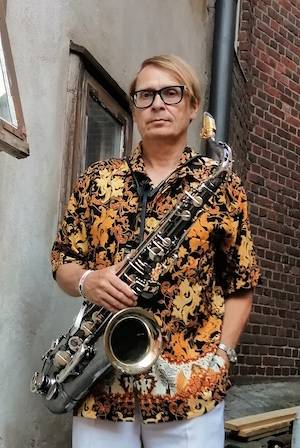
Laurin Rinder appears at 3:50, orange shirt.
Deprecated: Function eregi() is deprecated in /home/dreamchi/public_html/global/ads/banners/banner.php on line 12